
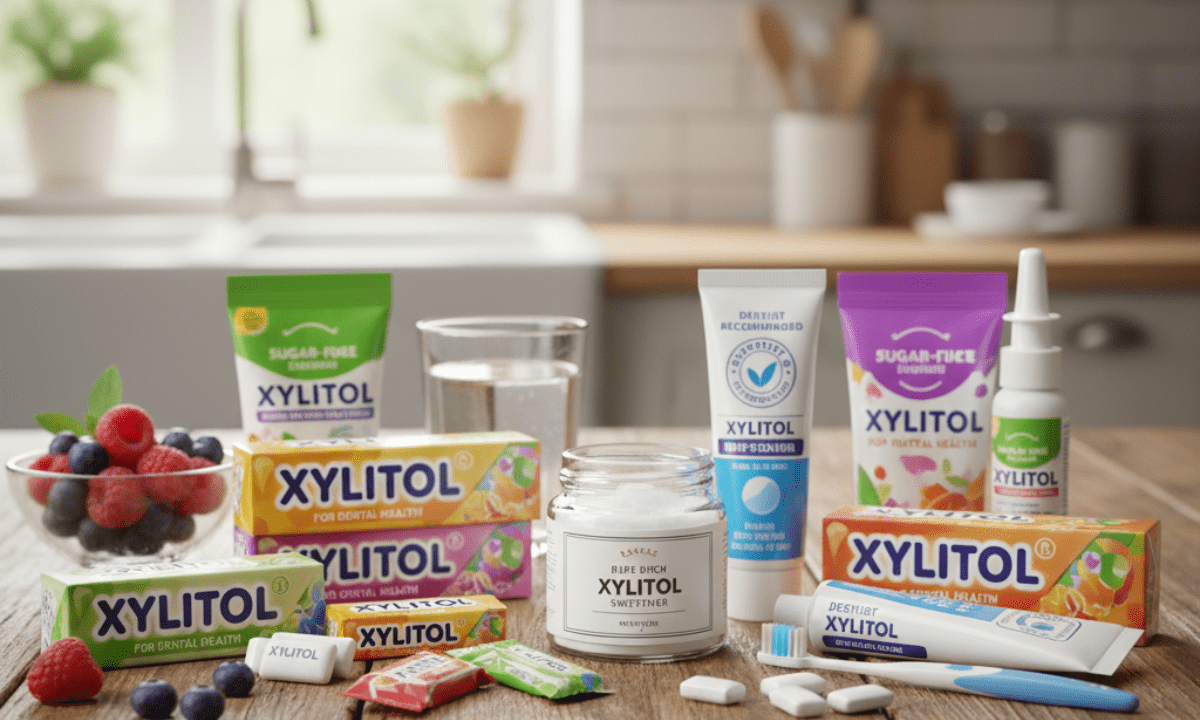
Xylitol is a clearly going on sugar alcohol (polyol) widely used as a sugar replacement. Regardless of its name containing “sugar,” Xylitol is a charming compound recognised for its sweetening power, its function in dental fitness, and its awesome metabolic pathway. Whilst it gives you sweetness similar to sucrose (table sugar), its shape and biological actions offer a compelling opportunity for the ones dealing with diabetes, weight, or seeking advanced oral hygiene. located naturally in small amounts in diverse fruits, veggies, and the bark of birch trees, Xylitol has advanced from a spot laboratory curiosity right into a mainstream ingredient in gums, sweets, and fitness dietary supplements globally.
I. Chemical Structure and Production
Chemically, Xylitol is a pentose alcohol, which means its molecular form functions 5 carbon atoms ($C_5$) and hydroxyl ($textOH$) groups connected to every carbon. Its formula is $C_5H_12O_5$. This symmetrical form is fundamental to its sweetness and its decreased caloric load.
The number one business production approach for Xylitol involves the hydrolysis of xylan, a hemicellulose polymer abundant in sources like birch wood, corn cobs, and sugar cane bagasse. The xylan is broken down into xylose, which is then purified and catalytically hydrogenated into Xylitol. This method is complex and resource-intensive, which is why Xylitol is commonly extra luxurious than conventional sugar or synthetic sweeteners like sucralose. However, more modern techniques exploring fermentation using microorganisms are being researched to improve efficiency and decrease manufacturing prices, probably expanding its availability.
II. Metabolic Advantages for Blood Sugar Management
One of the maximum substantial benefits of Xylitol is its impact on glucose metabolism. in contrast to sucrose or glucose, Xylitol is metabolized slowly and isn’t always dependent on insulin for its absorption into cells.
The important thing, metabolic figures for Xylitol are:
- Caloric content: about $two.4 textual content kcal/g$ (as compared to $four textual content kcal/g$ for sucrose).
- Glycemic Index (GI): Xylitol has a very low GI of about 7 to 13.
The low GI implies that ingesting Xylitol leads to a negligible spike in blood glucose and insulin levels. This makes it an exquisite sweetening agent for individuals with type 1 or type 2 Diabetes, offering them a way to experience sweetness without compromising their blood sugar manipulate. In the frame, Xylitol is in most cases processed within the liver, wherein it enters the gluconeogenesis pathway, producing compounds that can be used for power with minimum impact on systemic glucose.
III. The Cornerstone of Dental Health: Anti-Cariogenic Properties
One of the maximum enormous benefits of Xylitol is its effect on glucose metabolism. In comparison to sucrose or glucose, Xylitol is metabolized slowly and does not depend on insulin for its absorption into cells.
The $64000 component metabolic figures for Xylitol are:
- Caloric content: approximately $2.four textual content kcal/g$ (as compared to $4 textual content kcal/g$ for sucrose).
- Glycemic Index (GI): Xylitol has a very low GI of approximately 7 to thirteen.
The low GI implies that ingesting Xylitol ends in a negligible spike in blood glucose and insulin levels. This makes it an exquisite sweetening agent for individuals with type 1 or type two Diabetes, offering them a way to revel in sweetness barring compromising their blood sugar management. Within the body, Xylitol is, in most instances, processed inside the liver, wherein it enters the gluconeogenesis pathway, developing compounds that can be used for energy with minimal effect on systemic glucose.
IV. Other Potential Health Applications
Past blood sugar control and dental hygiene, Xylitol is being studied for its consequences on different areas of health:
- Ear and higher respiration health: Xylitol has been integrated into nasal sprays and syrups. Its mechanism here is just like that inside the mouth: it interferes with the adherence of bacteria, specifically those implicated in center ear infections (Otitis Media) and upper breathing infections, to the mucosal surfaces of the nose and throat. By means of reducing the bacterial load inside the nasopharynx it could help prevent those recurrent situations, specifically in toddlers.
- Bone Density: preliminary studies, generally in animal models, have cautioned that Xylitol may help improve bone density and mineral content, probably gaining a position in preventing age-related bone loss or osteoporosis. However, human trials are nonetheless required to verify this advantage.
V. Considerations and Safety Profile
Xylitol is commonly recognized as secure (GRAS) for human consumption with the aid of regulatory bodies like the FDA. The maximum common side effect is gastrointestinal misery, by and large osmotic diarrhea, particularly when consumed in large quantities. For the reason that Xylitol is not completely absorbed in the small intestine, it acts on the large intestine, where its presence draws water, main to a laxative effect. Character tolerance varies greatly.
Crucially, a vast safety caution needs to accompany any discussion of Xylitol: it is pretty poisonous to dogs. In canines, Xylitol is unexpectedly absorbed, main to a big, dose-based release of insulin that could cause a life-threatening drop in blood sugar (hypoglycemia) and capability liver failure. Even small quantities may be dangerous, and pet owners must exercise extreme caution.
In summary, Xylitol is a powerful and versatile polyol that has demonstrated its worth nicely beyond its function as a simple sweetener. From its low glycemic index reaping benefits for diabetics to its unequalled anti-caries action revolutionizing preventative dentistry, Xylitol stands as a testament to the fact that clearly derived compounds can provide significant and sudden blessings to public health.