
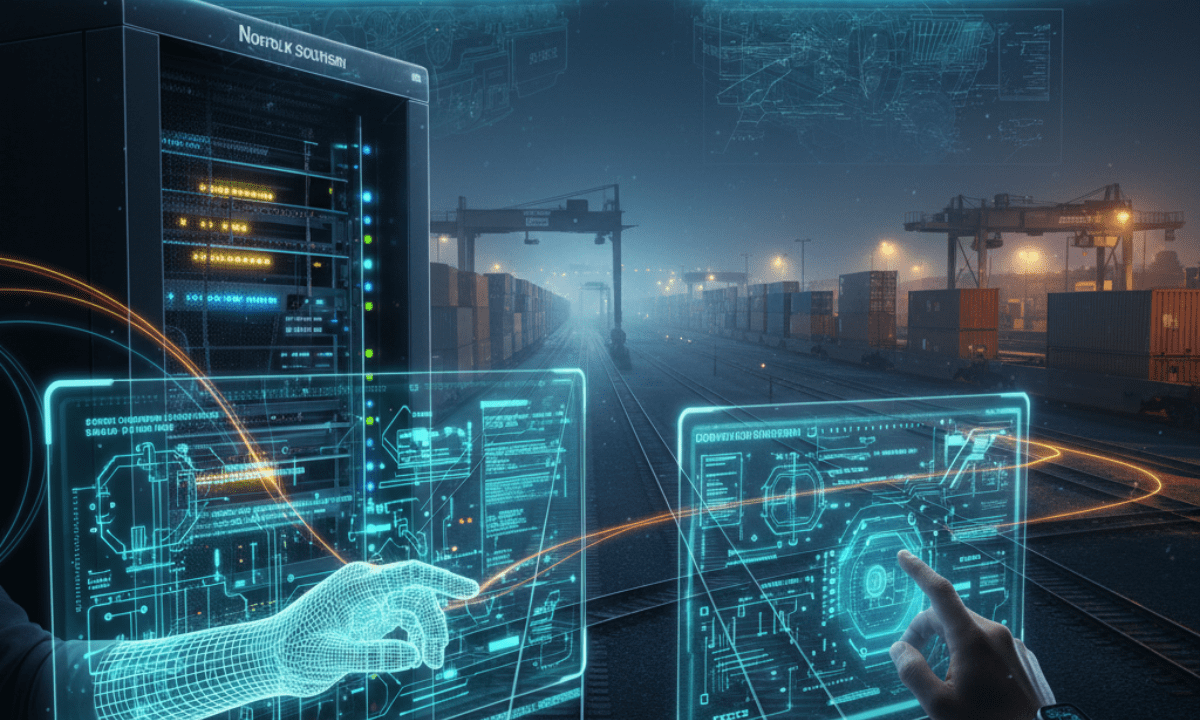
The enormous operational landscape of a category I railroad like Norfolk Southern organisation (NS), spanning over 19,000 direction miles and dealing with millions of freight moves annually, needs a technological core able to ensure absolute reliability and big data processing. While the corporation heavily invests in contemporary advancements like AI, gadget vision, and cellular applications, the unseen, challenge-vital foundation for these improvements stays the mainframe laptop system—often without a doubt mentioned internally because the NS Mainframe.
This article delves into the necessary function of the mainframe within Norfolk Southern’s current method, exploring its history, its particular benefits in an extreme-stakes transportation environment, and the way the organisation is strategically integrating this strong legacy system with modern digital transformation efforts.
I. The Mainframe’s Foundational Role in Rail Operations
The mainframe isn’t simply an antiquated pc; it’s far the centralized virtual brain that has controlled the complexity of the rail community for many years, a need born out of the dimensions and criticality of railroad logistics.
The Mandate of Middle Operations
Mainframes have been followed by rail predecessors because no different era could deal with the sheer volume and continuous nature of operational data. Nowadays, the NS Mainframe is still the authoritative device of file storage for critical enterprise methods:
- Vehicle Accounting and tracking: The mainframe tracks the location, route, and motion records of loads of lots of railcars, a challenge requiring real-time updates and ideal facts integrity. knowing precisely where each asset is—and in which it’s going—is the singular most important piece of logistical records.
- Centralized Operations management: It orchestrates schedules, protection guidelines, group availability, and instructs moves throughout the whole network. personnel perform a unmarried NS Mainframe login to get access to real-time information about shipment status, enabling centralized control of group duty cycles, maintenance work, and cargo loading.
- Billing and revenue: handling complicated tariff systems, processing electronic data interchange (EDI) messages with customers, and making sure accurate billing for full-size volumes of freight is an excessive-volume, excessive-price function for which the mainframe’s batch processing abilities are completely suited.
II. Why Mainframes Endure: Reliability and Security
Within the context of rail, where safety and operational continuity are non-negotiable, the mainframe’s architecture gives benefits that contemporary distributed systems often cannot match:
unmatched Uptime
The mainframe’s design prioritizes reliability primarily else. Modern-day systems, frequently running IBM z/OS, achieve “six nines” availability (99.9999% uptime), which means downtime is measured in seconds per year. For Norfolk Southern, which operates 24/7, this reliability translates directly into minimized safety dangers and prevented delays, which can be crucial for keeping an efficient carrier.
Cybersecurity and Compliance
By nature of their proprietary and insulated architectures, mainframes are inherently more difficult to attack than networked distributed systems. For managing sensitive operational and financial data, the built-in security features and strict access control (like the mandatory NS Mainframe employee login) are paramount. Furthermore, regulatory compliance, a significant factor in the rail industry, is often managed more securely and reliably on the well-established, auditable mainframe platform.
III. Modernization: Integrating the Core with the Edge
Norfolk Southern’s technology strategy is not about changing the mainframe, but about modernizing around it. The aim is to leverage the mainframe’s balance even as the use of current gear to provide real-time information and power innovation on the community’s part.
The position of APIs and mobile access
The method involves wrapping mainframe common sense in utility Programming Interfaces (APIs). Those APIs permit new, agile packages to speak seamlessly with the core systems.
- Cell Apps: teach crews and maintenance personnel to make use of NS Mainframe mobile apps to test painting schedules, receive immediate indicators (just like the CrewCall Mainframe gadget), and document defects with pics. This cell get entry to is crucial for rapid, area-based selection-making however relies on the mainframe for authoritative facts.
- Client Visibility: customers use contemporary portals and APIs to get real-time visibility into their shipments. This more suitable client revels in is powered by way of tightly closed, continuous information feeds from the mainframe.
Fueling AI and Predictive Analytics
Norfolk Southern’s dedication to becoming an “era-enabled railroad” is heavily reliant on advanced technology like self-sufficient music Inspection structures and AI-pushed safety predictions.
- information foundation: The mainframe acts as the tremendous, ancient data repository and machine of files that trains those device learning models. accurate, a long-time-vintage operational information is necessary to expect the whole lot from tune wear as much as five years earlier to locomotive health and capacity mechanical disasters.
- The energy of facts: The machine processes hundreds of updates every second, allowing sophisticated, automated logistics tools and the movement Planner to make real-time operational selections throughout the nineteen, two hundred-mile community. The reliability of the mainframe ensures the integrity of these facts, which, in turn, ensures the trustworthiness of the AI’s guidelines.
Conclusion
The Norfolk Southern Mainframe, some distance from being a legal responsibility, is an asset indispensable to the employer’s strategic desires of being the safest, maximum customer-targeted, and successful transportation enterprise in the world. Its inherent reliability and transactional strength provide the rock-stable operational basis indispensable to control the complexity of a country-wide rail network. Through pursuing a hybrid approach—integrating the strong center of the mainframe with agile, current mobile and AI-driven structures—Norfolk Southern guarantees that its technological backbone is strong ample to no longer solely preserve trains moving these days but to strengthen the incredibly optimized, safety-centered railroad of the future.
The subsequent video discusses how Norfolk Southern utilized technology to modernize its upkeep operations, demonstrating the sort of virtual transformation that relies on robust data infrastructure like the mainframe