
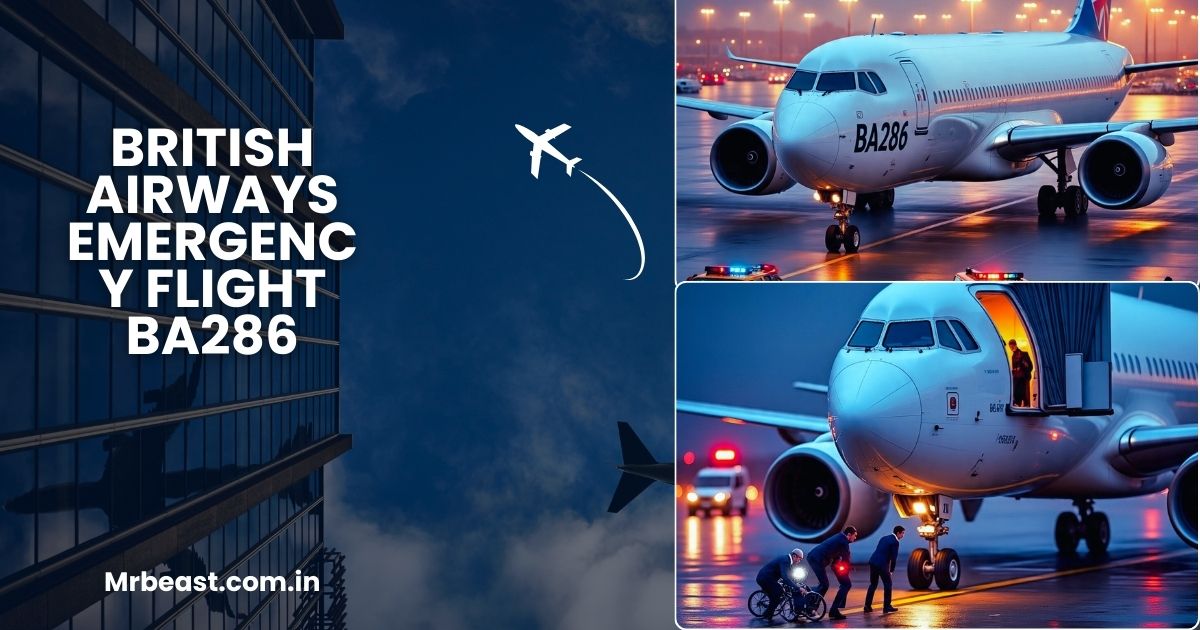
British Airways Flight BA286 is the scheduled provider between San Francisco global Airport (SFO) and London Heathrow (LHR), commonly operated with the aid of a wide-body aircraft, and on the evening of October 24, 2016, it used to be an Airbus A380 (Registration G-XLEB) carrying 388 passengers and 25 crew members. The flight started generally; however, about 2 hours into the lengthy-haul journey, while cruising at high altitude over western Canada, the state of affairs hastily devolved into a major airborne emergency.
The instant crisis and team Impairment
The incident started out when numerous cabin crew members stated a strong, noxious scent—defined through various people as similar to “pungent toes,” “burning plastic,” or “glue”—emanating from the area near the number 4 principal cabin door and the top flight deck galley. In a quick period, the situation escalated dramatically.
group members started to showcase signs and symptoms of incapacitation, including dizziness, nausea, reminiscence loss, confusion, and disorientation. Initial reports indicated that over a dozen group contributors confirmed symptoms of impairment, with some becoming unresponsive or being placed on oxygen. The severity of the group illness necessitated a right away response from the cockpit crew, who had been dealing with a widespread operational assignment: keeping control of the world’s largest passenger jet whilst key employees were probably compromised.
Recognizing the pressing threat to protection, the flight team consulted with the airline’s dispatch and declared a scientific emergency, signaling a PAN PAN (an urgent situation requiring priority coping with, but no longer instantaneous distress).
The Challenge of Diverting an A380
The decision to divert the flight used to be instant; however, the desire to exchange airports provided a complicated problem. The sheer length and weight of the Airbus A380 mean that no longer does each most important airport possess the crucial infrastructure to deal with it, including adequate gate size, de-fueling facilities, and emergency equipment.
- Preliminary goal: The team initially elected to divert to Calgary International Airport (CYYC), the closest appropriate essential airport in Alberta.
- change of design: however, upon consultation, the flight team was speedily advised that Calgary lacked the right facilities to house the A380.
- Final Diversion: The diversion was hastily changed to Vancouver Global Airport (CYVR) in British Columbia, which was once well ready to address the superjumbo aircraft.
To ensure a secure landing so soon after takeoff, the pilots have been required to reduce the plane’s weight below its maximum allowable landing weight. This necessitated a widespread, however dramatic, method: gas dumping. The A380 jettisoned lots of pounds of gas whilst over detailed far flung regions, permitting it to land adequately in Vancouver approximately a hundred and five minutes after the emergency used to be declared. As a precaution, the flight crew donned their oxygen masks throughout the latter levels of the flight.
The Ground Response and Controversial Aftermath
The touchdown at Vancouver was once uneventful, a testimony to the cockpit team’s professionalism. However, the scene at the tarmac underscored the seriousness of the event. The A380 was without delay surrounded by means of emergency cars and clinical staff, a few carrying shielding gear and respirators, and boarded the plane. This sight understandably caused considerable issues for some of the ultimate passengers, who had received restrained records throughout the emergency.
In total, 26 individuals—including all 3 pilots, 20 cabin crew members, and 3 passengers—were transported to local hospitals for assessment and remedy. Initial reports from health center spokespeople indicated that the group of individuals had been being handled for symptoms consistent with smoke or fume inhalation.
That is wherein the incident became debatable. British Airways issued a public announcement apologizing for the postponement; however, they asserted that the hospitalizations were “as a precaution” and that nobody had obtained a remedy for smoke inhalation. This discrepancy among the clinical reports and the airline’s public narrative fueled accusations from aviation safety advocates and change unions, notably Unite, that the airline industry consistently tries to downplay group exposure to toxic fumes, an ongoing safety concern within aviation.
The Unanswered Question of Fume Events
In the weeks and months following the diversion, the Transportation Safety Board (TSB) of Canada and British Airways investigated the cause of the noxious odor. Despite large tests, maintenance crews were unable to definitively determine the source of the fumes. The plane was once ultimately back in service, and the reliable research was once closed, barring a conclusive answer.
The BA286 incident remains an excessive-profile instance cited by companies campaigning for greater transparency and regulation regarding “fume occasions”—incidents in which oil or other contaminants enter the cabin air delivered through the engine bleed air device. Those events, even if non-fatal, can motivate persistent fitness issues for team participants and raise tremendous questions about the long-term protection of the air within industrial jets.
In the long run, British Airways Flight BA286 highlighted the skill and cool professionalism of its flight team under severe strain, but additionally amplified the necessary, unresolved debate surrounding cabin air protection and the transparency with which airways manipulate these serious, but regularly causeless, events.