
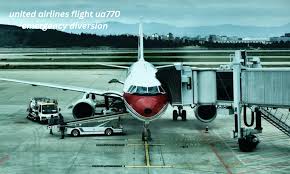
CHICAGO — inside the complex international of present-day aviation, protection protocols are the invisible framework that guarantees millions of passengers attain their destinations securely each day. These days, the highlight turned to a selected transatlantic route following an incident that triggered popular emergency measures. The United Airlines flight UA770 emergency diversion has turned out to be a topic of interest for aviation fans and frequent flyers alike, highlighting both the unpredictability of air travel and the rigorous training that pilots go through to address such events.
This newsletter examines the details of the incident, the operational realities of the Barcelona to Chicago route, and what passengers want to know approximately safety in the skies.
Anatomy of the Flight
United Airlines Flight UA770 is a frequently scheduled, long-haul carrier connecting Josep Tarradellas Barcelona-El Prat Airport (BCN) in Spain with Chicago O’Hare global Airport (ORD) in the USA. Normally operated by way of a Boeing 787 Dreamliner, this route spans approximately four 400 miles and takes nearly ten hours to complete. It’s a crucial corridor for commercial enterprise travelers and tourists, bridging Europe and the American Midwest.
But even the most routine flights can face surprisingly demanding situations. At some stage in a current operation, the group initiated a United Airlines flight UA770 emergency diversion sequence. Whilst “diversion” usually implies touchdown at an unscheduled airport, in high-priority emergencies, it can also refer to a thorough deviation from the same old flight path and method styles to expedite a landing at the vacation spot or a nearby hub.
The Incident Unfolds
In step with initial reports and flight monitoring records, the plane used to be cruising at altitude over the Atlantic Ocean while the state of affairs advanced. even as specific operational details are regularly covered in the course of active FAA investigations, assets recommend the pilots diagnose an anomaly, ranging doubtlessly from a mechanical sensor caution to a medical scenario on board.
In response, the flight deck communicated with Air Traffic Control (ATC) to declare a “Pan-Pan” or “Mayday” emergency, relying on the severity. This announcement is step one in a United Airlines flight UA770 emergency diversion. It presents the aircraft’s immediate priority over all other visitors, clearing the skies for a right-away route to the most secure runway.
For the passengers in the cabin, the enjoyment of a United Airlines flight UA770 emergency diversion may be unsettling. Eyewitnesses frequently document an unexpected exchange in engine pitch, a statement from the captain in a calm but association tone, and the motion of flight attendants securing the cabin for an expedited descent.
Why Diversions Happen
To understand the United Airlines flight UA770 emergency diversion, it is necessary to categorize why those occasions occur. Aviation policies are constructed on redundancy; if one device shows a fault, the aircraft can typically fly adequately; however, guidelines can also require it to land at the nearest appropriate airport.
- Clinical Emergencies: This is the maximum, not a common reason for unplanned landings. If a passenger suffers a cardiac event or severe allergy, pilots will execute a diversion to a town with sufficient hospital facilities.
- Mechanical indicators: cutting-edge aircraft have lots of sensors. If a sensor suggests a capacity difficulty—including low oil stress in one engine or a hydraulic irregularity—the team will opt for a United Airlines flight UA770 emergency diversion instead of continuing to complete the overall journey across the ocean or continent.
- Unruly Passengers: not often, protection threats or behavioral troubles inside the cabin necessitate an instantaneous touchdown to get rid of the disruptor.
Inside the case of UA770, the flight’s trajectory over the Atlantic gives confined diversion points (along with Keflavik in Iceland, or Gander in Newfoundland). Once the aircraft crosses into North American airspace, choices like Bangor, Boston, or a right-away precedence run to Chicago end up feasible.
The Passenger Experience
For those on board during the United Airlines flight UA770 emergency diversion, the timeline likely shifted from confusion to reassurance. Airlines instruct their crews to manipulate the “human element” of emergencies intensely. Flight attendants are the primary line of protection, making sure passengers remain seated and calm.
“We noticed the map on the screen trade, and the plane banked sharply,” is a commonplace sentiment shared by means of tourists in such eventualities. “The pilot told us we have been beginning a United Airlines flight UA770 emergency diversion because of an operational indication. It was frightening; however, the team appeared in overall managed.”
Upon landing, the difference between an ordinary arrival and an emergency one is stark. Emergency reaction vehicles—fire vehicles and ambulances—often chase the aircraft down the runway or meet it on the gate. This “rolling reaction” is a fashionable process, making sure that if there’s warmth in the brakes or a medical need, assistance is seconds away.
Operational Aftermath and Compensation
Once the plane is on the floor, the United Airlines flight UA770 emergency diversion transitions from an in-air event to a logistical task. If the diversion results in a specific town, the airline should secure accommodations, meals, and onward transport for masses of people.
In this recent example, United Airlines representatives were mobilized to help. The aircraft itself used to be immediately removed from the carrier for a thorough inspection by preservation teams. In aviation, an aircraft involved in a United Airlines flight UA770 emergency diversion does not fly again until every device is tested as a hundred percent purposeful. This abundance of warnings is why business aviation remains the most secure mode of transport.
For passengers, the delay is regularly mitigated by means of repayment rules. Relying at the reason of the United Airlines flight UA770 emergency diversion (controllable vs. uncontrollable), tourists might also get hold of vouchers or common flyer miles. United Airlines usually prioritizes transparency in these moments to maintain consumer faith.
Safety: The Bigger Picture
Critics and nervous flyers may view a United Airlines flight UA770 emergency diversion as a signal of failure. But, aviation professionals argue the opposite: it’s far from a signal of a system running precisely as supposed. Pilots are skilled at being chance-averse. The selection to divert is never taken lightly—it costs the airline lots of bucks in fuel and logistics—however, it is always taken if safety is even marginally in question.
The Boeing 787 Dreamliner working in the direction is designed with ETOPS (extended-range twin-engine Operational performance requirements) functionality, allowing it to fly thoroughly on a single engine for hours if necessary. A United Airlines flight UA770 emergency diversion is not often a “near miss” and extra frequently a proactive maneuver to avoid a “close call.”
Conclusion
Critics and nervous flyers may view a United Airlines flight UA770 emergency diversion as a signal of failure. But, aviation professionals argue the opposite: it’s far from a signal of a system running precisely as supposed. Pilots are skilled at being chance-averse. The selection to divert is never taken lightly—it costs the airline lots of bucks in fuel and logistics—however, it is always taken if safety is even marginally in question.
The Boeing 787 Dreamliner working in the direction is designed with ETOPS (extended-range twin-engine Operational performance requirements) functionality, allowing it to fly thoroughly on a single engine for hours if necessary. A United Airlines flight UA770 emergency diversion is not often a “near miss” and extra frequently a proactive maneuver to avoid a “close call.”